
Methane (CH4), the main component of natural gas, is at the heart of NaTran's activities and business lines: it has always been a safety issue for gas companies. Its role in global warming and, more broadly, general awareness of the issue, have also made it an environmental challenge. Two major challenges that have mobilized all NaTran teams. Explanations and outlook.
A lever in the fight against climate change
Methane has a greenhouse effect thirty times more powerful than CO2. Even though its lifetime in the atmosphere is twelve years, compared with several centuries for the same CO2, detecting and controlling its emissions is a strategic priority in the fight against climate change. The commitment of energy industry players to act in a more structured and massive way has been strengthened over the last decade. This is particularly true of the Oil and Gas Methane Partnership (OGMP 2.0), a United Nations environment program launched in 2020. This voluntary initiative brings together some two hundred member companies - including NaTran - with the ambition of optimizing reporting by creating accounting standards for the declaration of methane emissions, and then mitigating them.
Secondly, European Regulation 2024/1787 introduced a more ambitious and demanding regulatory framework last year, focusing on three key areas: quantification of emissions, control of diffuse leaks with repair obligations, and reduction of voluntary emissions with a zero discharge objective, meaning the end of venting in favor of reinjection into the network or, if necessary, flaring.
Long convinced of the need to reduce the environmental impact of its gas activities, NaTran is also developing the IMPACT program, for which Elodie Rousset is coordinator: "Our ambition is to reduce our methane emissions by 70% by 2030. With this in mind, my role is to identify the issues and explore solutions with the various teams in order to establish a technological roadmap."
Better detection
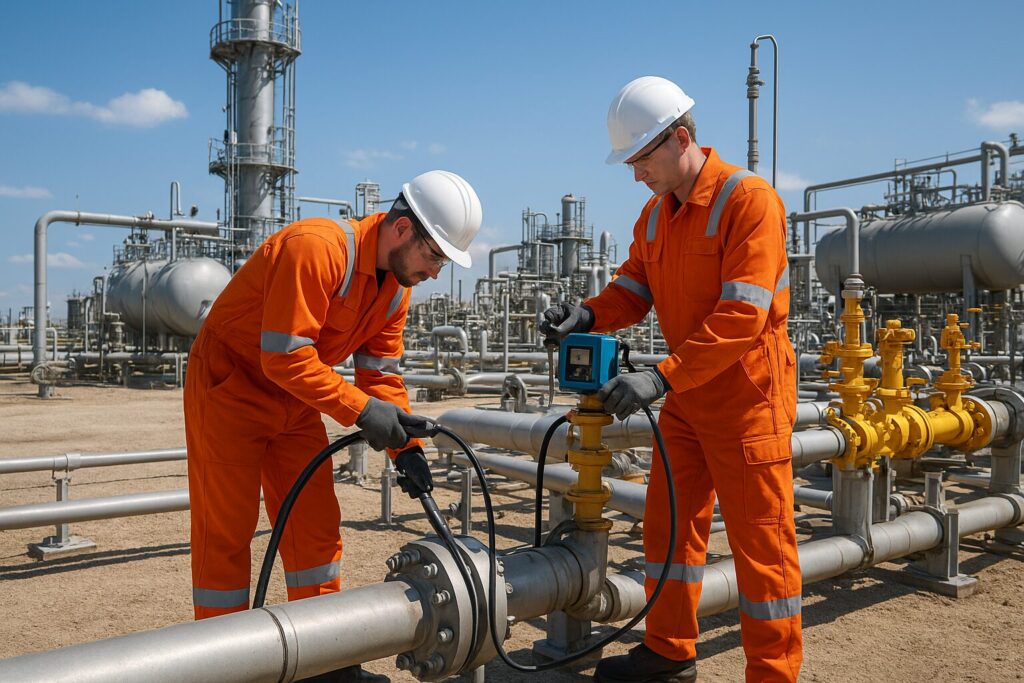
Until now, detection has been carried out using hand-held detectors designed to spot all leaks during foot patrols. Since the risk of under-estimating this method, known as source level, was considered too high , both the OGMP and the European Regulation called for the use of alternative control measures using drones or other vehicles, such as helicopters, equipped with an infrared detector. This is known as site level, and enables a concentration measurement in ppm delivered by the sensor to be converted into a leak rate based on a quantification algorithm and meteorological measurements.
To date, the recommendation for this type of campaign has been to target the sites with the highest emissions; but in time, all sites may have to be inspected. The latest operating mode currently being developed is continuous monitoring using fixed sensors. "So many operational and technical challenges for Natran R&I's teams, who strive to provide innovative, high-performance solutions", explains Cristina Lopez Lazaro, a specialist in methane emission detection, whose management she took over a year ago.
A collaborative, multidisciplinary approach
"The required intensification of detection campaigns requires a profound change in our practices," explains Jérémie Hosanski, Project Manager in the Operations Department, who adds, "and scaling up our existing technical solutions is complex." To overcome these difficulties, Cristina Lopez Lazaro encourages close dialogue between R&I and field teams: interaction with technical sponsors, listening to their needs, proposing technological innovations, feedback, partnerships with start-ups, etc.
The challenge of reporting
A corollary of detection is the quality of reporting : this is due to the variability of drone measurements - reliability of infrared equipment, meteorological instability - the imprecision of quantification algorithms and, to date, the partial nature of campaigns. NaTran R&I's expertise in reconciliation and uncertainty analysis is widely recognized. The OGMP Gold Standard, obtained by NaTran every year since 2023, bears witness to this. It's a legitimacy that Cristina promotes at international conferences and with new customers.
Buoyed by its clear and ongoing commitment to reducing its methane emissions, NaTran's expertise places it in an ambitious, highly demanding, but promising dynamic in the service of climate protection.