How can we reduce the oxygen content in biomethane injected into networks, without modifying producers' installations? NaTran R&I provides concrete answers through experiments carried out at seven producers.
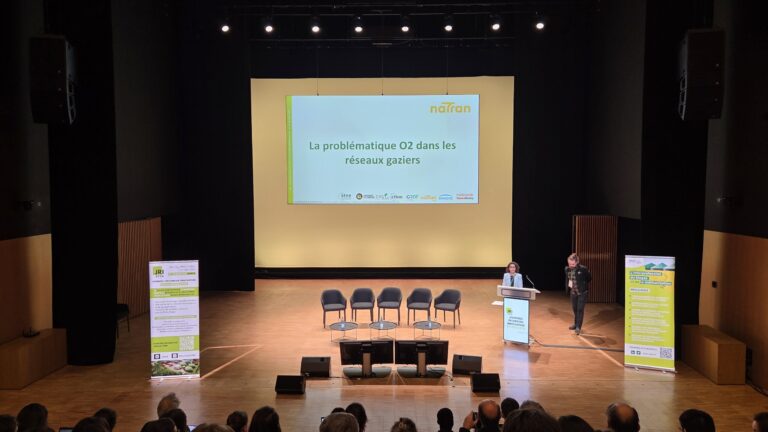
NaTran R&I was present at the Journées Recherche & Innovation Biogaz et Méthanisation (JRI 2026), held from March 17 to 19 at the Centre Prouvé in Nancy. On this occasion, our teams presented a poster detailing the results of a full-scale experiment on reducing O2 content in biomethane.

The presence of oxygen in biomethane is linked to the production and purification processes used upstream of network injection. Difficult to purify, residual O2 can have consequences for certain consumers and connected infrastructures. Although a threshold exemption exists to support the industry, controlling O2 levels remains a key challenge if biomethane is to continue to be integrated into the French gas mix.
In collaboration with CH4Process, NaTran R&I has carried out experiments at seven biomethane producers connected to the network. The approach adopted was to act solely on the parameters of the production process to reduce the O2 injected, without making any technical modifications to the sites.
Three phases were tested on each site: a long phase of optimized operation, a sprint phase pushing the reduction further over a short period, then a return to the conditions of the long phase.
The experiments revealed significant room for manoeuvre. The level of O2 injected could be reduced by 35% to 40%, while maintaining the quality of the biomethane produced and controlling the costs of the purification stage. The results also show a reduction in the use of O2 generators, paving the way for savings for producers.
The experiment also identified a number of technical limitations, particularly in terms of the accuracy of low O2 analyzers, which will guide the next stages of research.
The lessons learned from this work on reducing O2 in biomethane are shared with all producers and biomethane engineering teams. We are continuing to work with operators to disseminate best practices and further optimize O2 management in the industry.
Download the poster presented at JRI 2026 on reducing O2 content in biomethane (PDF)